






A buddy of mine texted me last week asking, “Is there actually anything decent under 35 grand right now, or is that still a fantasy?” I get this question a lot more than I used to. For years, “affordable EV” basically meant “compromise so much you’ll regret it.” I went down a rabbit hole comparing actual 2026 pricing — not last year’s numbers, not the “starting at” figures that quietly come with an asterisk — and the picture has genuinely changed. Some of it’s encouraging. Some of it comes with a catch you need to know about before you get excited.
Here’s my honest rundown of the five cheapest new EVs you can realistically buy right now, plus a couple of “almost made the list” notes that matter.
1. Chevrolet Bolt (2027 model) — around $28,995
The Bolt basically refused to die, and I’m kind of glad about it. It’s currently the cheapest EV on the market at $28,995 including destination charges.
The catch — and there’s always one — is range. The Bolt offers about 262 miles of range, which is fine for daily driving and most commutes, but it’s noticeably less than some of the other cars on this list. It also has a smaller 11.3-inch infotainment screen compared to newer rivals.
If your daily driving is mostly local — work, errands, school runs — the Bolt’s range won’t bother you much. If you regularly do longer trips without easy charging access, it’s worth cross-shopping before committing.
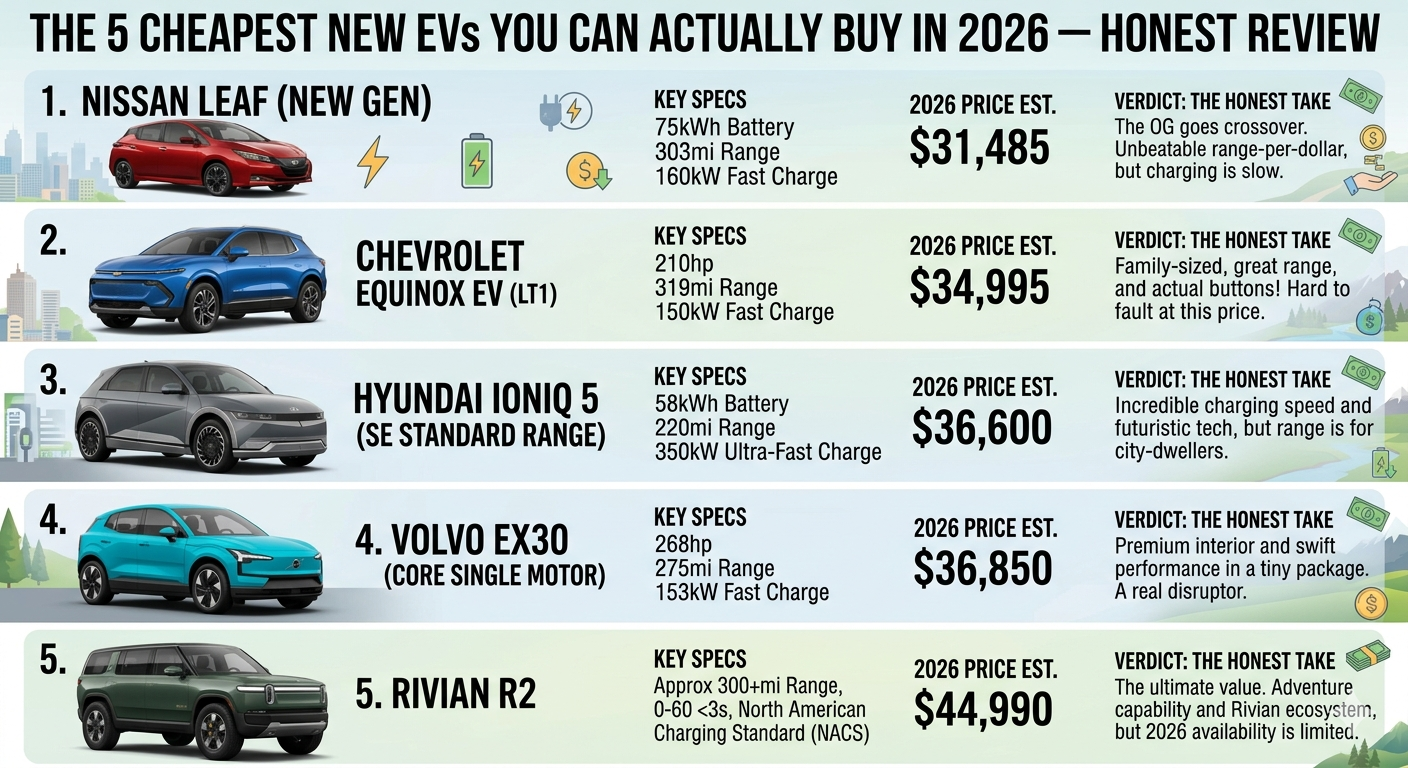
2. Nissan Leaf (2026, S+ trim) — $29,990
This one genuinely surprised me. Nissan announced the new Leaf will start at just $29,990, making it the cheapest new EV in America at the time of its announcement — and unlike the old Leaf, this one doesn’t feel like a budget afterthought.
The 2026 Leaf has been redesigned from a hatchback into a small SUV, with two charging ports — one of which is Tesla-compatible — and the S+ trim offers an EPA-estimated 303 miles of range. That range figure is honestly impressive for the price point.
Where it gets interesting is the trim ladder. Reviewers at Edmunds specifically called out the mid-tier SV Plus trim, starting around $34,230, as the sweet spot — for roughly $4,000 more than the base car, you get better upholstery, a bigger screen, more USB ports, rear air vents, and a heat pump for cold-weather efficiency.
One thing to watch: the Leaf only comes with one year of the Google software subscription, compared to multiple years on some competitors — easy to forget about until renewal time hits.
3. Chevrolet Equinox EV (2026, LT1 FWD) — around $30,295 with current discounts
This is the one I’d actually point most people toward right now, and the pricing situation is honestly a little chaotic in a good way.
With a current $6,500 customer cash discount, the base 2026 Equinox EV LT1 FWD starts at just $30,295 — and for that money, you’re getting up to 319 miles of range, more interior space than the Bolt or Leaf, and a massive 17.7-inch touchscreen, which is the largest in its class.
These discounts are part of GM’s broader push to keep EV sales moving after the federal tax credit disappeared at the end of Q3 2025, so I’d treat this pricing as “current as of now” rather than guaranteed forever — but as of writing, it’s a genuinely strong deal.
There’s also a software perk worth knowing about: the Equinox EV comes with an eight-year subscription to Google services (Maps, Assistant, Play Store), versus just one year on the Leaf. If you’re someone who actually uses those features daily, that’s real long-term value baked into the price.
Worth noting — the “official” non-discounted 2026 Equinox EV LT1 price actually went up to $35,100, so the $30k price tag depends on that discount sticking around. If you’re shopping later in the year, double-check current incentives before assuming this price still applies.
4. Volvo EX30 (2026, Single Motor Extended Range) — just over $40,000
This is where the list shifts from “budget commuter” to “affordable but still has some premium DNA,” and the EX30 is a genuinely interesting case.
Volvo finally delivered on its promise of a truly affordable EX30 with the Single Motor Extended Range model, priced at just over $40,000. This rear-wheel-drive version offers 268 horsepower and up to 261 miles of range, and comes with adaptive cruise control, a panoramic moonroof, and a 12.3-inch center screen as standard.
Here’s my honest take, based on what reviewers have flagged: the back seat is genuinely tiny — described as essentially uninhabitable by adults — and cargo space at 12.4 cubic feet is smaller than a Toyota Corolla’s trunk. So if you’re single, a couple without kids, or need a stylish second car, this could be perfect. If you need to regularly fit adults in the back seat or haul cargo, look elsewhere on this list.
One more thing worth knowing if you’re in the US: production of US-bound EX30 models has moved from China to Belgium, which is a meaningful shift for anyone tracking where their car (and its supply chain) comes from.
Important update if you’ve been specifically waiting on this model — Volvo’s lineup strategy is shifting, with the EX30 exiting and the larger EX60 becoming the focus of Volvo’s US electric strategy, with EX60 prices starting from $58,400. So if affordability is your main priority, grab the EX30 while it’s still available rather than waiting for what comes next from Volvo.
5. Hyundai Ioniq 5 (2026, SE RWD Standard Range) — $35,000
I almost left this off because it’s priced close to the Equinox, but the range and charging tech make it worth a mention. The base 2026 Ioniq 5 SE RWD Standard Range starts at $35,000 with 245 miles of range, while the SE RWD trim with the larger battery starts at $37,500 and offers up to 318 miles.
What you’re paying a bit extra for here is charging speed and overall build quality — the Ioniq 5 has consistently been praised for its 800-volt charging architecture, which means faster top-ups on road trips compared to some rivals on this list.
The Rivian R2 — why it’s NOT actually on this list (yet)
I know a lot of people are specifically searching for the Rivian R2 because of that much-talked-about $45,000 starting price. Here’s the reality check: the R2 is launching this spring, but only in the top-tier Performance trim, which costs $57,990 — that’s not cheap by any definition.
The actual $45,000 entry-level Standard trim won’t arrive until late 2027, and even the next step down — the Standard Long Range at $47,900 — isn’t coming until the first half of 2027 either.
So if you’ve been holding off on a purchase specifically because you’re waiting for “the affordable Rivian,” you’re looking at a wait of well over a year still. The R2 is absolutely one to watch for 2027, but it doesn’t belong on a “buy now” list for 2026.
Common mistakes I’d avoid if I were shopping this list
Don’t shop on “starting price” alone without checking what’s actually available to order now. Several of these prices (especially the Equinox EV discount) are tied to current promotions that could change.
Don’t assume range numbers translate directly to your climate. Cold weather can meaningfully reduce real-world range on any EV — something to factor in if you’re in a colder region.
Don’t skip checking state and local incentives. The prices above don’t include any state or local subsidies that may still be available, and with the federal credit gone, state-level programs matter more than ever.
My honest bottom line
If pure price is your priority and you can live with smaller range, the Chevy Bolt or Nissan Leaf are the real budget champions right now. If you want the best overall package for the money, the discounted Equinox EV is hard to beat — more range, more space, and a much bigger screen than its price suggests. The EX30 is the one I’d recommend only if you’ve actually sat in the back seat first, because that’s a genuine dealbreaker for some people. And the R2? Save it for your 2027 wishlist — it’s not a realistic 2026 purchase despite all the hype around its price point.