
A few months ago I was comparing notes with a friend who imports auto parts, and he said something that stuck with me: “Every container that comes in now, half of it is Chinese EV components — batteries, motors, controllers — and the prices keep dropping.” That casual comment is basically the whole story in miniature. China didn’t just enter the EV race late and catch up. It built the track, the cars, and increasingly, the export pipeline that’s now shipping electric vehicles to the rest of the planet.
I spent some time digging into where things actually stand in 2026, and the gap is bigger than most people realize — but the “what’s everyone else doing about it” part is where it gets genuinely interesting.
The numbers are honestly kind of staggering
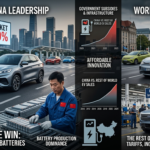
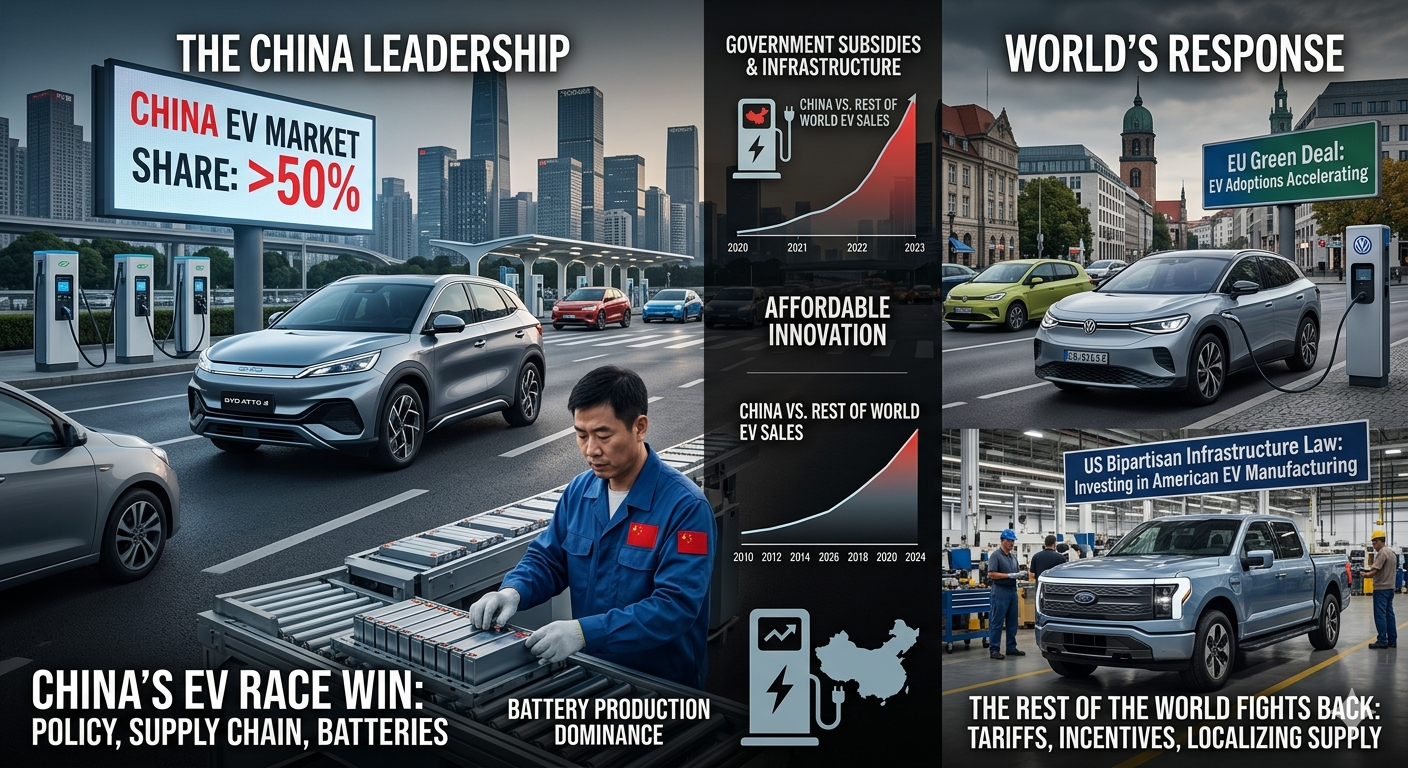
Let’s start with the headline figure. Global EV sales reached 20.7 million units through December 2025, up 20% year-over-year — and China holds 62% of that global market share. That’s not a slight lead. That’s nearly two-thirds of the entire global EV market belonging to one country.
Zoom into pure electric vehicles specifically, and China’s share of the global pure EV market has hovered around 63% from 2023 through 2025, though it dipped slightly to 56% in 2026 due to some early-year softness.
Here’s the part that really puts it in perspective for me — this isn’t a temporary spike. Under current policy trends, China is projected to account for roughly 57% of the global EV stock by 2030, which works out to around 238 million vehicles, and 53% of worldwide EV-driven oil displacement. That’s a 2030 projection built on momentum that’s already locked in today.
It’s not just cars — it’s the whole supply chain
This is the bit that I think gets underappreciated. People hear “China makes a lot of EVs” and picture finished cars rolling off a dock. But the real story is upstream.
China accounted for over 80% of global battery cell production in 2025, with even higher shares in the production of active materials used inside those batteries. And it’s not slowing down — the market share of Chinese battery producers is growing especially fast in the European Union, having almost doubled since 2023.
To put that in real terms: China’s demand for automotive batteries is projected to reach 1,516 GWh, representing 47% of the global total. So even when a car isn’t badged as Chinese, there’s a decent chance its battery — or the materials inside that battery — passed through a Chinese supply chain at some point.
That concentration cuts both ways though. Researchers modeling this out found a 92% probability that a moderate supply shock in China would trigger a severe global battery shortage. So “China dominates” also means “the rest of the world has a single point of failure,” which is exactly the kind of thing that’s been keeping policymakers in Brussels and Washington up at night.
Who’s actually winning inside China
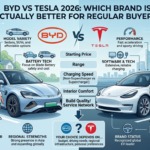
If you assumed Tesla was still the face of the EV boom, the data tells a different story now. By the end of 2025, BYD had clearly emerged as the global EV volume leader, selling well over 2 million EVs that year and edging past Tesla in annual global deliveries. Tesla is still hugely recognizable and its output remains massive, but the era when Tesla alone defined what “winning” in EVs looked like is over.
Inside China itself, the competition is brutal. As of April 2026, BYD ranks first in China’s NEV market with 21.4% share — and Tesla has actually fallen out of the top 10 entirely. That’s a remarkable shift if you think back to how dominant Tesla’s brand image was just a few years ago.
And it’s not just BYD. Other Chinese brands — Xiaomi, Geely, Chery, Lynk & Co, Wuling, and Zeekr — have all reported significant sales increases, and overall Chinese manufacturer EV sales grew roughly 45% year-over-year, with plug-in hybrid sales nearly doubling. That PHEV trend is worth noting — it suggests Chinese consumers (and increasingly export markets) aren’t just going all-in on pure battery EVs; flexible hybrids are picking up serious momentum too.
The export wave is the next chapter
Domestic dominance is one thing. What’s changing the global conversation now is exports.
China’s EV exports jumped 40% year-over-year in April 2026 alone, hitting 278,081 units. And the growth trajectory isn’t expected to slow — forecasts suggest Chinese EV exports to Europe could keep growing by around 20% annually between 2026 and 2028, which would make Europe one of China’s most important export markets for years to come.
There’s a wrinkle here though. In 2025, China’s EV exports actually exceeded overseas sales by more than 25%, meaning inventory has been building up — which could create headwinds for Chinese exporters in 2026 if that excess inventory doesn’t find buyers fast enough.
Meanwhile, what’s happening everywhere else?
This is where the picture gets genuinely uneven depending on which region you’re looking at.
Europe is the front line of this story right now. With Chinese EV exports to the EU accelerating and battery supply chains shifting in China’s favor, European automakers are caught between protecting domestic manufacturing and needing affordable EVs to hit climate targets. Despite increasing trade barriers, tariff concerns, and geopolitical tensions, Chinese automakers continue expanding aggressively into international markets — so whatever defensive measures Europe puts up, the pressure keeps building.
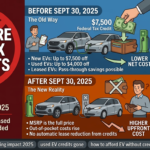
The United States is, frankly, pulling in the opposite direction. With the expiration of the federal EV tax credit, EV market share in the US is expected to edge down to around 6% in 2026, compared to roughly 7.5% in 2025. So while China is accelerating, the US market is actually shrinking its EV share — at least for now. General Motors, Honda, and Volkswagen made the largest US EV sales gains, even as overall domestic EV sales dropped 2.6%, and Toyota continues to lead overall US auto rankings while EV demand remains limited.
Globally, the IEA’s outlook is interesting because it’s not doom-and-gloom for EVs broadly — it’s more about who benefits. The IEA projects EVs could reach around 50% of global car sales by 2035 as cost-competitiveness improves and emissions standards tighten, while sales of combustion engine cars continue shrinking and never return to their 2017 peak. The growth is real — it’s just that China is positioned to capture an outsized share of it.
Why this actually matters to regular people, not just industry analysts
I know “global market share” can feel like an abstract statistic that doesn’t touch your life. But here’s where it does:
If you’re shopping for an EV in the next year or two, there’s a real chance that even a “European” or “American” branded vehicle has Chinese-made battery components inside it — and that affects pricing, supply timelines, and even what happens if there’s a geopolitical dispute that disrupts that supply chain.
If you’re in a market where Chinese brands are entering directly (parts of Asia, Latin America, and increasingly Europe), you’re likely to see more affordable EV options hitting the market faster than domestic manufacturers can match — which is great for buyers in the short term, but raises longer-term questions about where service, parts, and software support will come from.
And if you’re in the US specifically, the dynamic is almost the reverse of the rest of the world — the market’s pulling back a bit just as China’s pushing forward, which could widen the technology and cost gap over the next few years rather than closing it.
My honest read on where this goes next
What strikes me most isn’t just that China is ahead — it’s how structurally deep that lead is. This isn’t “one good car model” or “one popular brand.” It’s batteries, raw materials, manufacturing scale, domestic competition that’s brutal enough to keep prices low, and now an export engine that’s accelerating into the exact regions (Europe, Latin America, parts of Asia) where EV adoption is still ramping up.
The rest of the world isn’t standing still — trade barriers, domestic incentives, and new manufacturing investments are all real responses. But based on the trajectory in front of us, closing this gap looks less like a sprint and more like a multi-year structural shift, if it happens at all on the current timeline.
If you’re someone who tracks this stuff because you’re planning a purchase, my suggestion is simple: keep an eye on where your specific market sits in this picture, because the next 2-3 years are likely to bring more change here than the previous five did combined.