




Six months ago, I handed over the keys to my old petrol car and drove home in something completely different. I’d read every article, watched a dozen YouTube reviews, and still felt like I was stepping into the unknown a bit. Half a year and a few thousand kilometers later, I figured it’s worth writing down what actually happened — the good, the annoying, and the stuff nobody really mentioned.
This isn’t a “10 reasons to buy an EV” listicle. It’s just what living with one has actually been like.
Week one: the small things hit first
The first thing that struck me wasn’t the acceleration or the tech — everyone talks about that. It was how quiet everything was. Closing the door, starting it up (there’s no “starting” really, it just… wakes up), pulling out of the driveway. My neighbor literally didn’t hear me leave one morning and was surprised to see the car gone.
The second thing was the instant torque. Pulling into traffic, merging onto a busy road — that immediate response without any lag took some getting used to. I caught myself accelerating a bit harder than intended a few times in that first week, just because it responds so differently than what I was used to.
What I did NOT expect: how much I’d enjoy the regenerative braking. It took maybe three days to stop feeling weird and start feeling natural — the car slows down when you lift off the accelerator, almost like engine braking but stronger. Once it clicked, I found myself barely touching the brake pedal in normal city driving.
Setting up charging — my honest mistakes
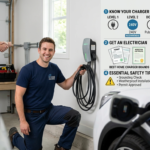
I wrote about this in detail in a separate guide, but the short version of my personal experience: I delayed getting a proper home charger installed for the first three weeks because I figured “I’ll just use the regular outlet for now.”
Big mistake. Charging from empty-ish to full on a standard wall outlet took close to 13 hours. That’s fine if you genuinely never drive much and always plug in overnight — but the one time I came home with the battery lower than usual after a longer day out, I genuinely worried about whether I’d have enough charge for the next morning’s commute. That was the moment I called an electrician.
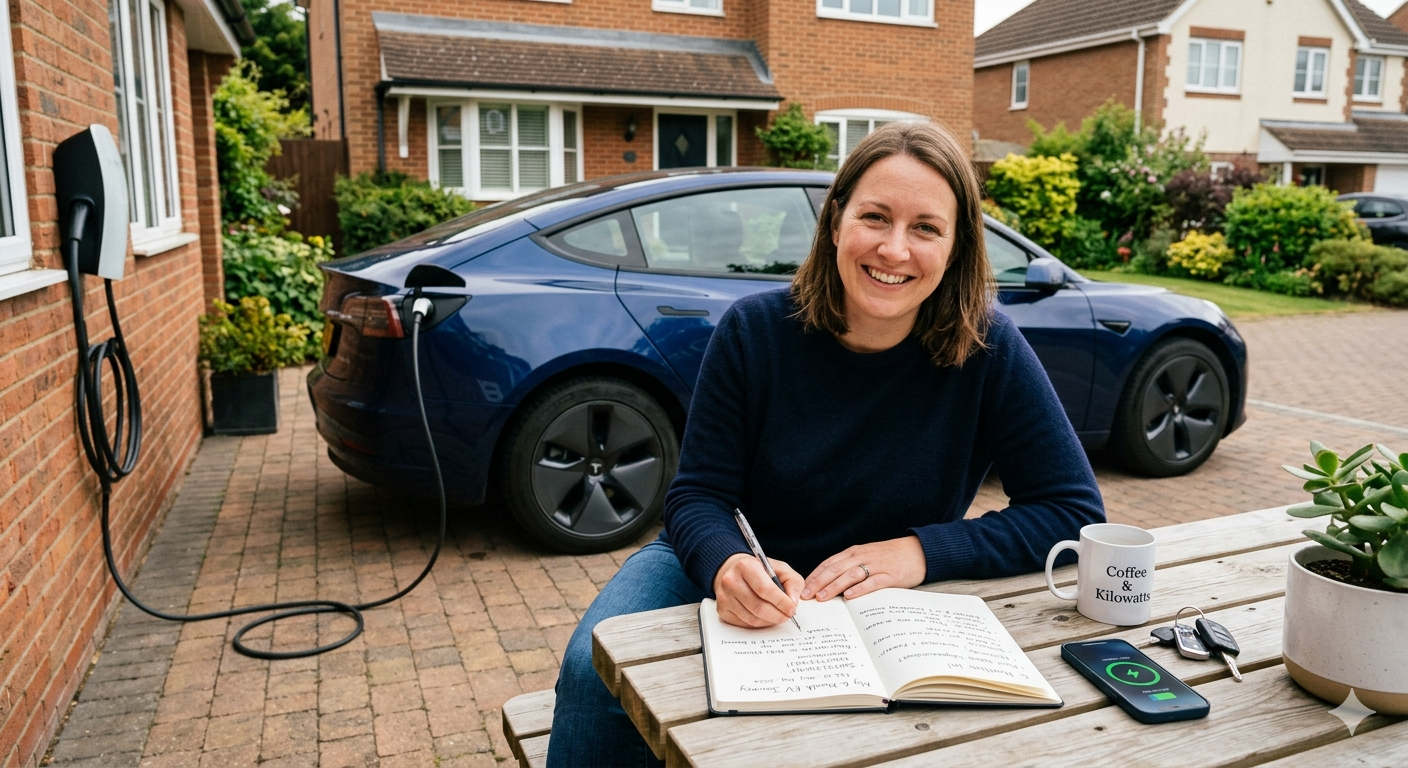
Getting the Level 2 charger installed took about two weeks from the initial call to the electrician finishing the job — mostly because of scheduling, not the work itself, which took half a day. Since then, charging has been a complete non-event. I plug in when I get home, it charges overnight, I unplug a full battery every morning. I genuinely don’t think about it anymore, which is honestly the biggest lifestyle shift — no more “oh I need to stop for fuel” mental tax that I didn’t even realize I was carrying around.
Range in real life vs. what the spec sheet says
This is the section I think people actually want to read, because manufacturer numbers and real life don’t always match.
My car’s rated range is solid on paper. In practice, here’s what I’ve found:
On a warm day, doing a mix of city and highway driving, I get pretty close to the rated number — sometimes even slightly over if I’m driving gently.
On the highway at higher speeds (think motorway speeds, not city cruising), range drops noticeably. I’ve found that backing off my speed by just a little bit makes a bigger difference than I expected — not a huge sacrifice in travel time, but a real difference in how much range I use.
Cold mornings are where the gap is most noticeable. The first really cold week we had, I watched the range estimate drop faster than the distance I was actually covering — which was unsettling the first time it happened, until I realized it’s mostly the cabin heater and battery conditioning working overtime, not the car suddenly becoming less efficient at driving.
My fix for this, which actually works: I started using the seat heater more and the cabin heater less on short trips. It sounds like a small thing, but it noticeably helped on cold-morning range anxiety days.
The savings — this is where it got real
I kept a rough log of my charging costs versus what I used to spend on petrol, mostly out of curiosity more than discipline.
The difference is bigger than I expected, but not in the way I initially thought. My electricity bill did go up — that’s just math, charging a car uses electricity. But when I compared the increase in my electricity bill against what I used to spend on petrol every month, the EV came out significantly cheaper, even accounting for the higher electricity usage.
The part that surprised me: I’m saving more on “in-between” costs than I expected. No oil changes. My mechanic looked at the car at the 6-month mark mostly out of curiosity and said there’s basically nothing to service yet beyond a tire rotation. That’s money and time I used to spend without really thinking about it.
I haven’t hit any major maintenance milestones yet (brake pads, etc.) so I can’t speak to those long-term costs firsthand — that’s a “check back in a year” kind of thing.
What actually annoyed me (because nothing’s perfect)
A few honest gripes, in no particular order:
The first one is public charging anxiety, even though I barely use public chargers. On the rare occasion I needed one — a longer trip than usual — I found the experience more inconsistent than I expected. Some chargers worked perfectly. One was just… out of service, with no clear signage about it until I’d already pulled up. I ended up driving to a different location. It wasn’t a disaster, but it was the first time I felt a flicker of “oh, this is the thing people complain about.”
The second is one-pedal driving habits transferring badly to other cars. I drove a friend’s petrol car for an afternoon and kept reaching for the brake way too early out of habit, because I’d gotten so used to the regen braking doing most of the work. Not a big deal, just an adjustment.
The third is more of a “me” problem than a car problem — I keep forgetting the car doesn’t need to “warm up” in the traditional sense, so on cold mornings I sometimes still sit there for a minute out of old habit before realizing there’s nothing to wait for.
What genuinely surprised me (in a good way)
The cabin pre-conditioning feature. Being able to warm up (or cool down) the car from inside my house before walking out to it, using the app, felt like a small luxury at first and now feels like something I’d genuinely miss if I went back to a petrol car.
How much quieter my daily commute feels — not just the engine noise, but overall. Less road noise feels noticeable too, though I’m not sure if that’s the car itself or just less engine vibration making everything else more apparent.
The software updates. My car has actually gotten small feature improvements via updates since I bought it — nothing dramatic, but a couple of small UI tweaks and one update that improved how the navigation handles charging stop suggestions on longer trips. That’s just not something that happened with my old car.
Would I go back?
Honestly — no, and that surprised me a little, because I went into this fairly neutral. I wasn’t an EV evangelist before buying one; I was mostly driven by the cost comparison making sense for my situation.
But six months in, the things that won me over weren’t the things I expected. It wasn’t the “save the planet” angle or even primarily the cost savings (though those are real). It was the day-to-day stuff — the quiet, the not-stopping-for-fuel mental relief, the pre-conditioning, the lack of oil-change errands.
What I’d tell someone considering the switch
Get your home charging sorted before you need it, not after — my three-week delay was a genuinely unnecessary stress I created for myself.
Don’t panic about the cold-weather range drop — it’s real, but it’s manageable, and small habit changes (seat heaters, slightly lower highway speeds) make a real difference.
Public charging is still the rougher edge of the experience, even six months in. If your daily routine is mostly home-charging based, this barely affects you — but don’t assume public charging will be flawless if you do need it occasionally.
And honestly — give the regenerative braking and one-pedal driving a real chance before judging it. It felt strange for about three days and then became one of my favorite parts of driving the car.
I’ll probably write an update at the one-year mark, especially once I’ve got real data on tires and brakes. For now, though — six months in, no regrets, and a few habits I didn’t expect to pick up.