
A reader emailed me last month with a question that’s basically impossible to answer in one line: “I keep seeing BYD overtook Tesla — does that mean BYD makes better cars now, or is this just a numbers game?” Fair question. And honestly, the more I dug into it, the more I realized this isn’t really a “which brand won” story. It’s a story about two completely different philosophies, and depending on where you live and what you actually need from a car, the “better” answer changes a lot.
Let me walk through what I found.
The sales race is closer (and weirder) than the headlines suggest
Here’s the thing that surprised me most: the “BYD overtook Tesla” narrative and the “Tesla reclaimed the crown” narrative are BOTH true — just at different points in time, and for different reasons.
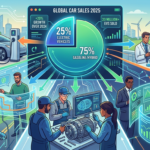
BYD sold about 2.26 million fully electric vehicles in 2025, up 28% year-over-year, comfortably outpacing Tesla’s roughly 1.64 million deliveries, which were down about 8.5%. Including plug-in hybrids, BYD’s total 2025 sales reached around 4.6 million units — a number that got reported widely as BYD “easily outstripping” Tesla.
But then 2026 opened differently. In Q1 2026, Tesla delivered 358,023 vehicles compared to BYD’s roughly 310,000 — a lead of about 47,000 vehicles, putting Tesla back on top globally. According to the South China Morning Post, BYD’s Q1 2026 sales of 310,389 units were down 25.5% year-over-year.
So what actually happened? BYD’s decline was largely driven by new EV taxes, stricter regulations, and policy changes within China that hit domestic demand and pricing. In other words — this swing says less about which company makes a better product and more about how exposed each company is to a single market’s policy decisions.
The core philosophical difference — and why it matters to you
This is the part I think actually matters for a regular buyer, more than who’s “winning” any given quarter.
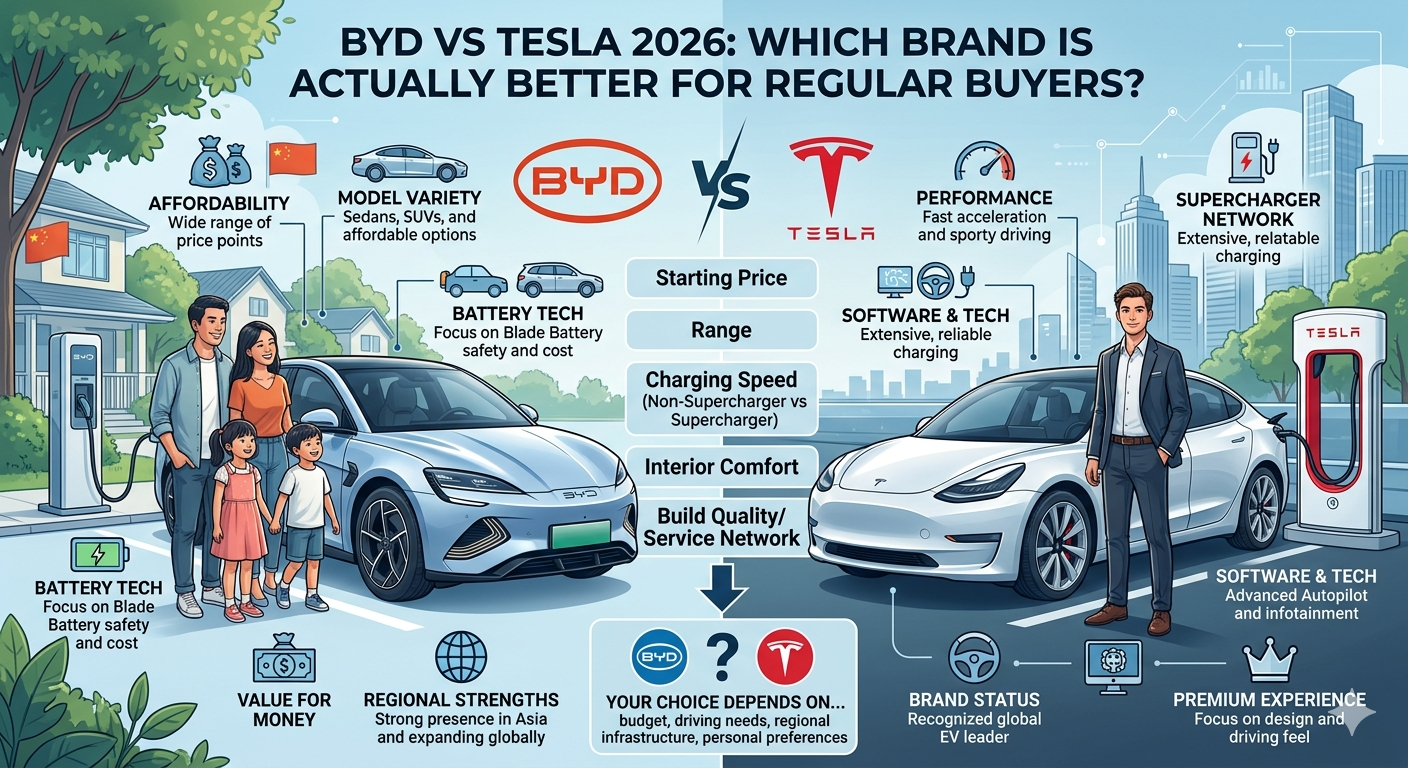
BYD covers essentially every segment with both battery-electric and plug-in hybrid models — from urban cars like the Dolphin Surf, to family SUVs like the Atto 3 and Seal U, to premium sedans like the Seal. Its roughly 50/50 BEV/PHEV mix is specifically designed to capture buyers who aren’t ready to commit fully to electric and still want the option of gasoline for certain trips.
Tesla takes the opposite approach. Tesla specializes in a small number of highly efficient pure-electric models — the Model 3 and Model Y account for about 90% of its sales in the mid-premium segment, with no plug-in hybrid option at all — Tesla is betting entirely on full electrification.
Practically speaking: if you’re not 100% sold on going fully electric yet, or if your driving includes long trips where charging infrastructure is still patchy, BYD’s PHEV lineup gives you an option Tesla simply doesn’t offer. If you’ve already made peace with full EV ownership and want a company laser-focused on that, Tesla’s narrower lineup might actually be a feature, not a limitation.
Why BYD can price so aggressively
One thing that genuinely surprised me digging into this: BYD’s cost advantage isn’t just about cheaper labor or government subsidies — it’s structural.
BYD has a massive advantage in vertical integration — its subsidiary FinDreams Battery manufactures battery cells in-house, and according to UBS analysis, around 75% of a BYD Seal’s components are made in-house, compared to 46% for a China-made Tesla Model 3. That’s a huge gap, and it translates directly into lower production costs that BYD can pass on to buyers.
This is also reflected in battery technology choices. BYD relies on long-lasting LFP (lithium iron phosphate) batteries, while Tesla uses its own 4680 cell technology focused on minimizing consumption — two different bets on what matters more: battery longevity and cost (BYD) versus efficiency and range-per-charge (Tesla).
The head-to-head matchups people are actually searching for
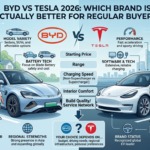
If you’re cross-shopping specific models, here’s where the real decision happens. The comparison that’s defining purchasing decisions in the premium family segment right now is BYD Seal versus Tesla Model 3, and BYD Seal U versus Tesla Model Y — these are similarly-sized D-segment vehicles with comparable pricing that put the two brands directly face to face.
The general positioning is: BYD offers immediate value with its pricing and feature set, while Tesla bets on superior technological efficiency. If you’re the kind of buyer who cares most about getting the most car for your money right now, BYD’s value proposition is hard to ignore. If you prioritize efficiency, charging network, and software polish, Tesla’s case is still strong.
Where each brand is actually available — this might decide it for you
Here’s a practical reality check that a lot of comparison articles skip: you might not actually be able to buy both of these cars, depending on where you live.
BYD now operates in more than 100 countries across six continents and actually outsold Tesla in both Germany and the UK in 2025. But BYD remains completely locked out of the US market, facing tariffs exceeding 100% along with national security concerns.
So if you’re in the US, this entire comparison is currently theoretical — Tesla is your only option between these two, at least for now. If you’re in Europe, the UK, or many parts of Asia, Latin America, or the Middle East, both brands are realistically on the table, and the Seal vs. Model 3 / Seal U vs. Model Y comparisons become genuinely relevant to your shopping decision.
Worth watching: BYD is expanding its European manufacturing footprint with a new plant in Hungary, and along with Geely and Chery is reportedly considering entering Canada, where roughly 49,000 China-made EVs are allowed in at lower tariff rates — a move that’s drawn criticism from the United States. If that Canada move happens, it could be the first real crack in BYD’s North American absence.
What’s coming from each brand
Tesla has discontinued the Model S and Model X, reportedly to free up manufacturing capacity for its Optimus humanoid robot and Cybercab robotaxi projects — though this isn’t expected to significantly affect Tesla’s overall EV sales, since the Model 3 and Model Y have long been its stronger sellers anyway. Tesla’s future lineup is expected to include the Roadster and lower-cost robotaxi-style EVs, though these aren’t yet available as mainstream sales models.
BYD, meanwhile, is playing a different long game. Even with its 2025 sales slowdown, the company has narrowed its 2026 sales target to 4.6 million vehicles — about a 16% cut from earlier projections — and says future growth will depend on new models and expanding exports rather than just riding domestic Chinese demand.
The stock market sees these companies very differently — and that tells you something
This isn’t directly about which car to buy, but it’s a useful signal about how each company is positioned. Tesla trades at a price-to-earnings ratio over 300 with a $1.4 trillion market cap, while BYD’s market cap sits around $140 billion — roughly a 10x gap despite BYD outselling Tesla in EVs for most of 2025.
Tesla stock gained 11.4% in 2025 and hit a record high in late December, while BYD’s US-traded shares rose 7.6% but ended the year about 40% below their May 2025 peak. The market is essentially betting that Tesla’s value lies well beyond car sales — software, robotics, AI, and energy storage — while BYD is valued more straightforwardly as a (very large) car manufacturer.
So — which is actually better for a regular buyer?
Honestly, I think the question itself needs splitting up:
If you’re in the US: this is currently a non-question. Tesla is your option, full stop, unless BYD’s tariff situation changes.
If you’re in Europe, UK, or a market where both are sold: it comes down to what you value. If you want maximum features and value for your budget, and you like having a hybrid option as a safety net, BYD’s lineup — especially the Seal and Seal U — gives you more for less. If you want a brand laser-focused on pure EV efficiency, a mature Supercharger network, and software that’s been refined over a decade, Tesla still holds genuine advantages.
If you’re tracking this as a “who’s winning” story for fun: stop checking quarterly sales figures as a tiebreaker. As 2026 has already shown, these numbers swing hard based on regional policy changes that have nothing to do with which car is actually better — and ultimately, this rivalry pushing both companies to compete on price and technology is something that benefits buyers either way.
My honest take: if both are available where you live, I’d test-drive both rather than picking based on sales headlines. The “winner” of this rivalry changes every few months — your daily driver shouldn’t be chosen based on a stat that’ll be different by the time you’re done reading this article.