There’s a quote that’s aged spectacularly badly. Back in 2011, a Bloomberg interviewer asked Elon Musk what he thought about BYD — a Chinese company making electric cars and buses. Musk laughed. Not a polite chuckle. A genuine, sustained laugh. Then he said he didn’t think they had a great product.
Fast forward to January 2, 2026. BYD released its full-year 2025 sales numbers: 2.26 million pure battery electric vehicles delivered globally, up 28% year-over-year. Tesla? 1.64 million — down nearly 10%. For the first time in history, a Chinese automaker had dethroned the company that essentially invented the modern EV era.
Then things got complicated. BYD’s domestic sales fell for eight straight months into early 2026, profits collapsed by more than 55% in Q1, and Tesla quietly clawed back the global BEV crown in the first quarter. A lot of headlines declared BYD’s moment over before it really began.
They were wrong. And the May 2026 numbers just proved it.
What Actually Happened in May
BYD’s total new energy vehicle sales reached 383,453 units in May — enough to end the streak of year-over-year sales declines that had persisted since late 2025. More significantly, sales climbed nearly 20% from the 321,123 vehicles sold in April, signaling a strong rebound driven almost entirely by overseas markets.
The real headline was international. Overseas sales surged to a record 160,644 units in May, representing an 80.4% increase from the same period last year. International markets accounted for approximately 42% of BYD’s total NEV sales during the month.
Let that number breathe for a second. Nearly half of everything BYD sold in May went to buyers outside China. A year ago that would have been unthinkable for a company most Western consumers still can’t confidently pronounce.
This is not a blip. BYD’s total overseas deliveries for the first four months of 2026 reached 455,707 units, putting it firmly on track toward its full-year target of 1.5 million vehicles sold outside China. They’ve already raised that target once — it was bumped up from previous guidance of 1.3 million, signaling a strategic shift toward global markets as domestic competition intensifies.
Understanding Why China Got Messy
To make sense of the comeback, you need to understand why things got rough in the first place — because it wasn’t a product failure. It was a policy whiplash that would have hurt any automaker.
China ran an aggressive EV subsidy program through 2024 that made electric vehicles genuinely affordable for millions of buyers. When those subsidies were restructured — and a new 5% purchase tax applied to EVs that were previously exempt — Chinese consumers did what consumers always do when an incentive disappears: they rushed to buy before the deadline, creating a massive pull-forward effect in late 2024, then went quiet in early 2026.
BYD’s first-quarter net profit fell over 55% year-on-year to 4.09 billion yuan, squeezed by price wars and rising hardware costs. China’s EV market had become a knife fight — too many brands, too many models, all competing on price in a market where demand had temporarily softened. The financial impact was significant, and in response, BYD launched over ten new models and is betting on its second-generation Blade Battery and ultra-fast charging technology to win back ground at home.
But here’s the thing about a company that builds its own batteries, its own semiconductors, and its own software: when your domestic market gets complicated, you pivot. Fast.
The Global Expansion Play
BYD’s international strategy in 2026 is genuinely impressive in its scope. They’re not just shipping cars from Chinese factories to foreign ports. They’re localizing manufacturing, designing market-specific products, and playing a long game that most Western automakers aren’t even attempting.
In Brazil: BYD kicked off production at its new Camaçari plant in Bahia — built in just 15 months — and rolled out its first locally made model, the Dolphin Mini, which became Brazil’s best-selling EV with over 34,000 units sold. The facility represents a $1 billion investment with annual capacity of 150,000 vehicles and supports 20,000 jobs. BYD also posted a monthly registration record in Brazil in April.
In Europe: This is where the strategy gets genuinely interesting. Rather than just selling Chinese-designed cars with European price tags, BYD is now designing cars specifically for European buyers. The Dolphin G DM-i marks the first vehicle BYD specifically developed for overseas markets, a compact plug-in hybrid hatchback aimed at Europe’s competitive B-segment offering more than 1,000 kilometers of combined range.
BYD’s executive VP Stella Li has been refreshingly blunt about what she wants: “Our goal is for customers to think of BYD as a European brand.” That’s not marketing fluff — she told Autocar that BYD will launch a wave of models designed and developed in Europe for Europe over the next three years, starting with the plug-in hybrid Dolphin G.
The reasoning for European-specific design is sharp. Li explained that in China, competition is making cars “bigger and bigger and the chassis wider and wider,” which makes those vehicles impossible for Paris, Milan, Rome, or London — where people still prefer smaller-sized cars.
That’s not a generic market statement. That’s a company paying close attention.
In Southeast Asia and beyond: The Dolphin Surf became the best-selling EV in South Africa as of January 2026. BYD now builds vehicles locally in Thailand, Hungary, and has facilities in Turkey and Indonesia. The manufacturing footprint is being built to outlast tariff headwinds — because you can’t easily slap tariffs on a car built in Szeged or São Paulo.
BYD vs. Tesla: The Real Scorecard
Let’s be honest about what this rivalry actually looks like right now, because the headline numbers can be misleading.
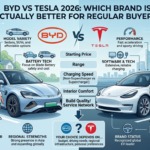
On pure BEV deliveries in Q1 2026: Tesla reported 358,023 deliveries from January to March, a 6.5% increase year-over-year, while BYD recorded 310,389 pure EV deliveries — a 25% year-over-year decrease — giving Tesla a lead of roughly 47,000 units. So yes, Tesla retook the BEV crown in Q1.
But zoom out: When you include plug-in hybrids — which BYD sells in massive volumes — BYD sold nearly double the number of cars compared to Tesla overall in Q1, with 695,772 new energy vehicles globally.
On 2025 as a whole: BYD’s battery-powered car sales rose nearly 28% to 2.26 million units in 2025, while Tesla’s deliveries dropped 8% year-on-year to 1.64 million.
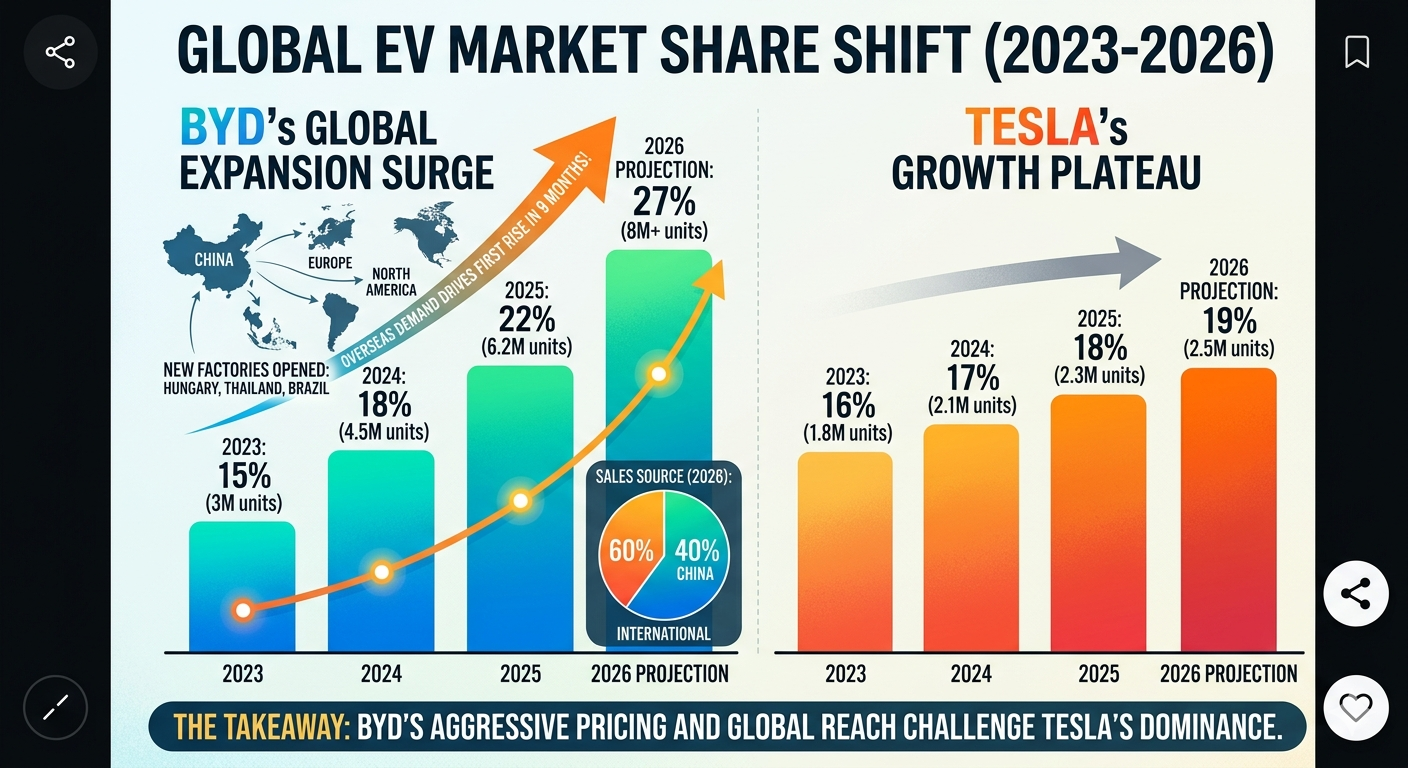
On market share trajectory: In 2025, BYD captured roughly 18–19% of the global EV/NEV market. Tesla’s global BEV share slipped to around 7.8–8%.
The nuance here matters: Tesla and BYD are genuinely competing in different segments of the same market. Tesla is a premium software-first brand with strong margins on fewer models. BYD is a volume-first manufacturer with vertical integration that gives them cost advantages at every price point. Tesla’s strength is the Model Y and Model 3 dominating premium mass-market EV sales globally. BYD’s strength is the sheer breadth of what they offer — from a $10,000 city car in China to the Yangwang supercar priced above $2.7 million unveiled at the Beijing Auto Show.
These two companies can both “win” in a global EV market that’s still only scratching the surface of its potential.
That said, there’s one enormous asterisk on BYD’s global ambitions.
The America-Shaped Hole in BYD’s Map
BYD is selling record numbers in Europe, Southeast Asia, South America, and Australia. You know where you won’t find a BYD? An American dealership.
The company remains largely shut out of the United States due to steep tariffs, and is instead focusing overseas expansion on Europe, Southeast Asia, and South America.
The US tariff situation — which has escalated significantly under the current administration — has essentially walled off the American consumer from what is arguably the most price-competitive EV lineup in the world. A BYD Seagull equivalent sells in China for roughly $10,000. Americans are paying $35,000+ for comparable EVs.
This is where the BYD story gets genuinely political, and I’ll leave the policy debates to people more qualified than me. But from a pure consumer standpoint, American EV buyers are being denied access to a wave of affordable options that the rest of the world is getting — and that gap is only going to widen as BYD’s international lineup matures.
What BYD’s Comeback Actually Signals for the Industry
The May numbers aren’t just good news for one Chinese automaker. They tell us something bigger about where the global EV market is heading.
Global EV demand is more resilient than the skeptics claimed. Every time US policy pulled back from EVs, analysts started writing obituaries for the transition. But BYD selling 160,000 vehicles overseas in a single month — mostly to buyers in Europe, Southeast Asia, and South America — is proof that the demand story is real and genuinely global.
The next competitive battleground is price. BYD’s strategy is built on making EVs so affordable that the “premium” argument for keeping a gas car stops making sense. The Dolphin G DM-i, designed specifically for Europe, is expected to start from under £20,000 in the UK — which would make it the smallest and cheapest plug-in hybrid on sale in the country. When a company is bringing a feature-loaded PHEV to Europe at that price point, every legacy automaker’s volume segment is under pressure.
Manufacturing localization is the moat. The Brazil factory, the Hungary plant, the Turkey facility — BYD isn’t just exporting cars. It’s building infrastructure that makes it genuinely hard to push them out of markets through tariffs. That’s a playbook Japan used in the 1980s and 1990s, and it worked.
Vertical integration is BYD’s real weapon. They make their own Blade batteries. Their own chips. Their own software. Their own motors. When commodity prices swing or supply chains get disrupted, BYD has levers that almost no other automaker has. The company has deployed its 5,000th flash charging station and plans to scale this to 20,000 units by the end of 2026, spanning 297 cities with further expansion planned across highways and international markets. They’re building the ecosystem around the car, not just the car.
What This Means If You’re Actually Buying a Car
If you’re in the US, BYD isn’t on your shopping list yet and probably won’t be for a while. But the pressure BYD is putting on global pricing is already filtering through — it’s part of why used EV prices are falling, why new EV transaction prices are narrowing versus gas cars, and why companies like Hyundai and Toyota are working harder to be cost-competitive.
If you’re in Europe, Southeast Asia, Australia, or South America, BYD is now a legitimate first-look option — not a curiosity. The Dolphin, Seal, Atto 3, and incoming Dolphin G are genuinely well-reviewed cars with competitive pricing and increasingly solid dealer networks. The stigma of “Chinese brand” is fading fast when the alternative is paying €10,000 more for a European badge.
And if you’re watching this industry the way I do, BYD’s comeback in May 2026 is a reminder that the companies writing EV obituaries after a rough quarter are usually missing the larger arc. Eight months of domestic pain, a Q1 profit collapse, Tesla reclaiming the BEV crown — and BYD responded by breaking its overseas sales record two months in a row.
Elon Musk isn’t laughing now. And honestly? The global EV buyer is probably better off for it.
Sources: Electric Cars Report (May and April 2026 BYD sales data), Macao News, CnEVPost, Inside EVs (Q1 2026), CNBC (full-year 2025 data), Autocar, CleanTechnica, EV.com, Statista, TipRanks (Brazil factory).