

A practical guide from someone who spent three weeks deep in the used EV rabbit hole
My brother-in-law called me in April asking if he should buy a “used Tesla or just get something new.” Simple question, right? Forty-five minutes later we were still on the phone, arguing about battery degradation, CPO warranties, and whether a 2022 IONIQ 5 with 34,000 miles was actually a good deal at $28,500.
That conversation made me realize how many people are staring at the used EV market right now — genuinely interested, but completely unsure what they’re walking into.
And honestly? The timing makes total sense. Gas just crossed $4.20 a gallon nationally. New EVs still carry a price premium most people can’t stomach, especially after the federal $7,500 tax credit quietly expired in September 2025. Meanwhile, the used EV market has been quietly getting flooded with off-lease vehicles — cleaner, newer, better-specced cars than anything that hit the used lot two years ago.
So let me break this down the way I wish someone had broken it down for me.
Why the Used EV Market Is Suddenly Huge
A wave of EVs bought during the 2021–2023 tax-credit boom are now coming off their three-year leases. Edmunds data shows that EVs are expected to make up 8% of used vehicle lease returns in 2026 — up from just 2% last year. That’s a fourfold jump in supply hitting dealership lots in a single year.
The result? Prices have dropped fast. The average used EV in March 2026 was selling for around $34,650 — down about 6% from a year earlier. And 44% of used EVs that sold in March went for under $25,000. Compare that to the average used gas car at about $33,550, and you’re looking at a premium of barely $1,100 for a used EV. A year ago that gap was nearly $4,000.
For context: a 2023 Chevy Bolt EUV — a perfectly capable, well-reviewed electric car — is routinely selling used for $19,000 to $23,000 right now. A 2022 Kia EV6 with decent range is sitting at $26,000–$30,000 at most dealers. These numbers would’ve been unthinkable in 2022.
So the supply is there. The prices are there. The question is whether a used EV is actually safe to buy — and how you do it without getting burned.
The New vs. Used Breakdown: What You Actually Get
Let’s be real with each other. New and used EVs are not the same product, and pretending otherwise would be doing you a disservice.
Buying new gets you:
- Full manufacturer warranty (typically 5 years bumper-to-bumper, 8 years / 100,000 miles on the battery)
- Latest hardware, software, and safety tech
- No battery degradation at all
- Peace of mind, basically
Buying used gets you:
- Significantly lower upfront cost (often $10,000–$20,000 less for a 2–3 year old car)
- The first owner already absorbed the worst of the depreciation hit
- More choice at lower price points, especially under $30K
- Some risk around battery health and remaining warranty coverage
Here’s the thing nobody says out loud: most used EVs are fine. The horror stories about batteries dying at 60,000 miles are largely outdated. Modern lithium-ion battery packs — especially from Hyundai, Kia, Tesla, and Chevrolet — hold up remarkably well when they’ve been charged responsibly. Real-world studies have consistently shown that most EVs retain 80–90% of their battery capacity even after 100,000 miles.
The risk isn’t that used EVs are inherently bad. The risk is buying one without knowing its history.
Battery Health: The One Thing You Cannot Skip
This is the make-or-break step, and a surprising number of buyers skip it because they don’t know it exists.
Before buying any used EV, you want a battery health report. Here’s how to get one depending on the brand:
Tesla: Any Tesla service center can run a battery diagnostic. You can also use the Tesla app or a third-party tool called Tessie or Stats for Tesla to check capacity and charging data if the previous owner will share account access temporarily.
Hyundai / Kia (IONIQ 5, EV6, etc.): Ask the dealer to run a Health Check Report through their GDS (Global Diagnostic System). It spits out the state of health as a percentage. Anything above 85% on a 3-year-old car is solid.
Chevy Bolt / EUV: These have a publicly accessible battery state of health display right in the instrument cluster under Energy menu. Go look at it before you buy.
Nissan LEAF: This is the one where I’d be extra cautious. The older LEAFs (pre-2018) use a different battery chemistry that degrades faster and doesn’t have liquid cooling. Check the capacity bar display — it shows remaining battery in bars. A 2019+ LEAF with the 40kWh or 62kWh pack is a different, much better story.
General rule: If a seller refuses to let you check battery health or won’t provide a diagnostic report, walk away. A well-maintained EV has nothing to hide.
You can also use a third-party pre-purchase inspection service. Companies like Lemon Squad and FIXD do mobile EV inspections and will flag battery, charging port, and software issues before you sign anything. Worth the $150–$200, especially on private party purchases.
Warranty: What’s Still Covered and What Isn’t
Federal law requires EV manufacturers to warranty the battery pack for at least 8 years or 100,000 miles — whichever comes first. That warranty is tied to the vehicle, not the original owner, so it transfers when you buy used. A 2022 EV with 40,000 miles still has battery warranty coverage until 2030 or 100K miles.
Bumper-to-bumper is a different story. Most manufacturer warranties are 3–5 years, so a 2021 EV’s factory bumper-to-bumper has likely already expired or is close to it.
Your options:
A Certified Pre-Owned (CPO) program is the cleanest path. Tesla, Hyundai, Kia, and Chevrolet all have CPO programs that include inspections, extended coverage, and sometimes roadside assistance. Tesla’s CPO vehicles come with a 4-year / 50,000-mile limited warranty added on top of remaining coverage. Hyundai’s CPO program extends coverage significantly and includes a multipoint inspection.
If you’re buying from a private seller or a used-car lot that doesn’t offer CPO, look into third-party extended warranties from providers like Endurance, CARCHEX, or your own insurer’s vehicle protection plan. Read the fine print carefully — some exclude “wear items” like brake pads and tires, which matters less for EVs but is still worth noting. Also confirm that EV battery coverage is explicitly included; some older plans excluded it.
Where to Actually Buy a Used EV Safely
Not all used car marketplaces are created equal, and this is somewhere a lot of first-time buyers make avoidable mistakes.
Best places to shop:
Carvana and Vroom are solid for convenience and return policies (Carvana’s 7-day return window is genuinely useful). They do condition inspections and provide vehicle history reports. Prices tend to be slightly higher than private party, but you’re paying for the process protection.
CarMax has dramatically expanded its used EV inventory in 2026 and reported a noticeable spike in EV page views since gas prices spiked. They offer their own MaxCare extended service plan and a 30-day return guarantee, which is basically unheard of in traditional used car sales.
Dealer CPO programs are where I’d look first for anything under 3 years old. Hyundai and Kia dealers in particular have been moving CPO IONIQ 5s and EV6s at prices that are genuinely competitive with private party listings, with the added peace of mind.
Facebook Marketplace and private sellers can get you the lowest prices, but you carry all the risk. If you go this route, hire that third-party inspector, run the CarFax or AutoCheck report, and always meet at a charging station so you can watch the car actually charge (unusual charging behavior is a red flag).
PlugStar is a free tool from Plug In America that helps you find EVs and EV-friendly dealers near you — underused, genuinely helpful.
Used EVs to Target (and One to Approach Carefully)
Strong picks in the used market right now:
2022–2023 Hyundai IONIQ 5 — Premium interior, ultra-fast 800V charging, excellent range. Used prices around $27,000–$33,000. One of the most well-reviewed EVs of the last few years, and lease returns are flooding the market.
2022–2023 Kia EV6 — Same platform as the IONIQ 5, slightly sportier feel, comparable range and charging speed. Similar price range.
2021–2023 Tesla Model 3 — The most available used EV out there. Good range, excellent Supercharger network, over-the-air software updates keep older cars feeling current. Standard Range models going for $22,000–$27,000.
2022–2023 Chevy Bolt EUV — Wildly practical for daily driving, tons of them available, and prices have dropped under $20,000 for early 2022 models. Not fast, not flashy, but it does the job really well.
2021–2022 Ford Mustang Mach-E — Bigger, more SUV-like, and prices have come down considerably. Good option if you need more cargo space.
Approach with care:
Pre-2019 Nissan LEAF — older battery tech, no liquid cooling, can degrade faster in hot climates. The newer LEAFs are fine; the old ones need extra scrutiny on battery health.
Common Mistakes First-Time Used EV Buyers Make
Skipping the battery check. I keep coming back to this because it’s the most common and most costly mistake. Spend the time and, if needed, the money to verify it.
Assuming “used” means “unreliable.” For EVs, used often means better value. The mechanical simplicity of EVs — no transmission, no oil, fewer moving parts — means they age better than gas cars in many ways.
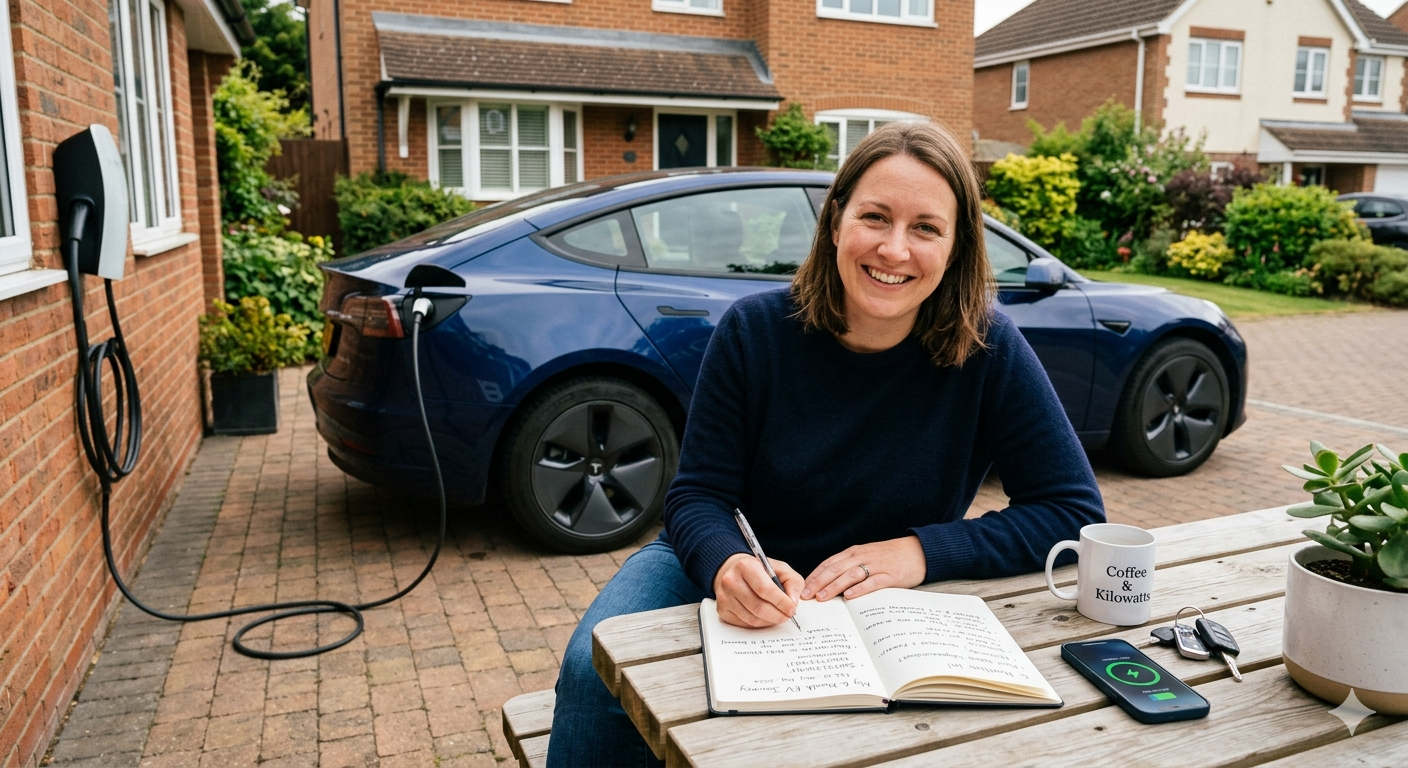
Forgetting about charging at home. You can find a great used EV deal, but if you live in an apartment without a dedicated outlet, you’ll be dependent entirely on public charging. Map out your situation before you buy, not after.
Not accounting for software. Older EV models on outdated software sometimes miss features that newer firmware versions added. Tesla handles this best with OTA updates. Other brands vary. Ask what version the car is running and whether it’s still receiving updates.
Buying the wrong size battery for your commute. A 150-mile range car is perfectly fine for a 40-mile daily commute. But if you’re driving 70 miles each way and don’t have workplace charging, you need to do that math before falling in love with a deal.
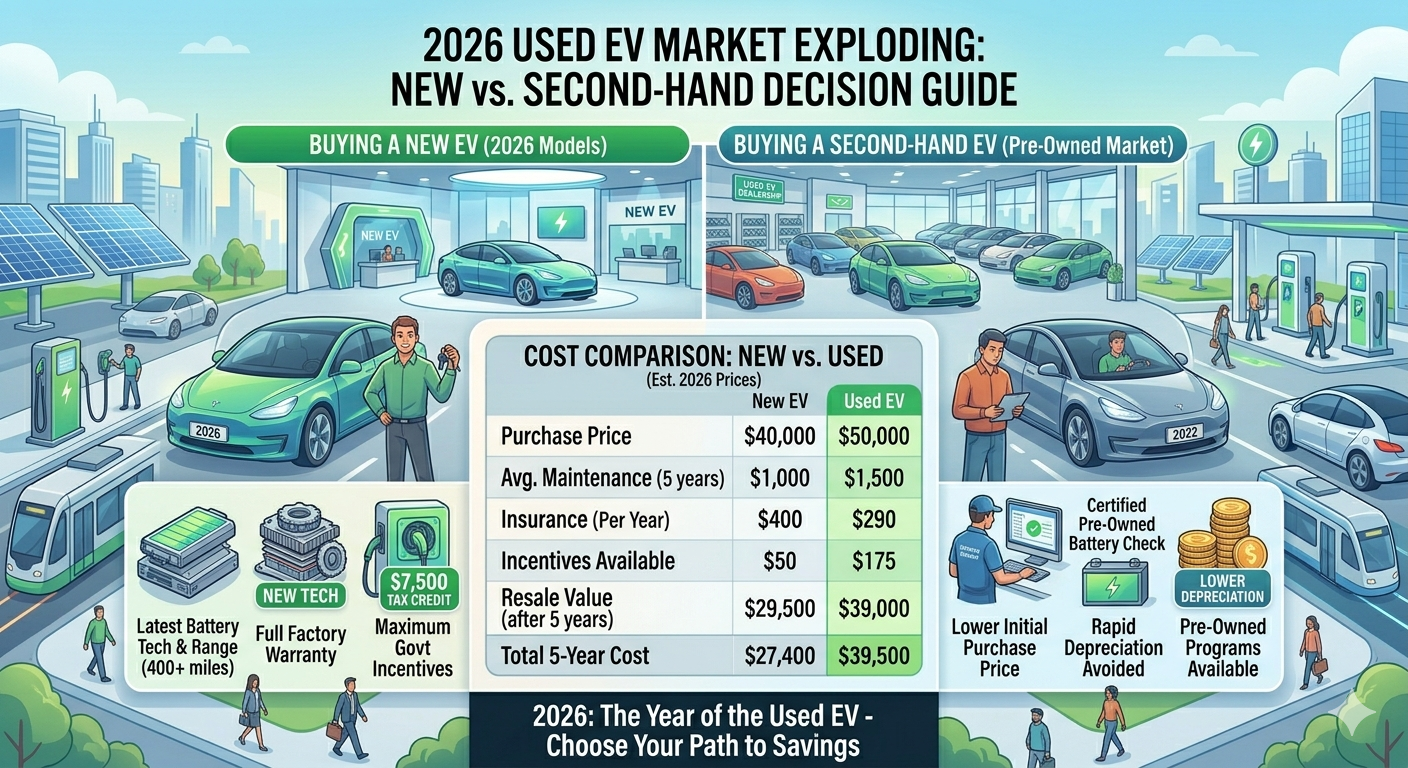
So — New or Used?
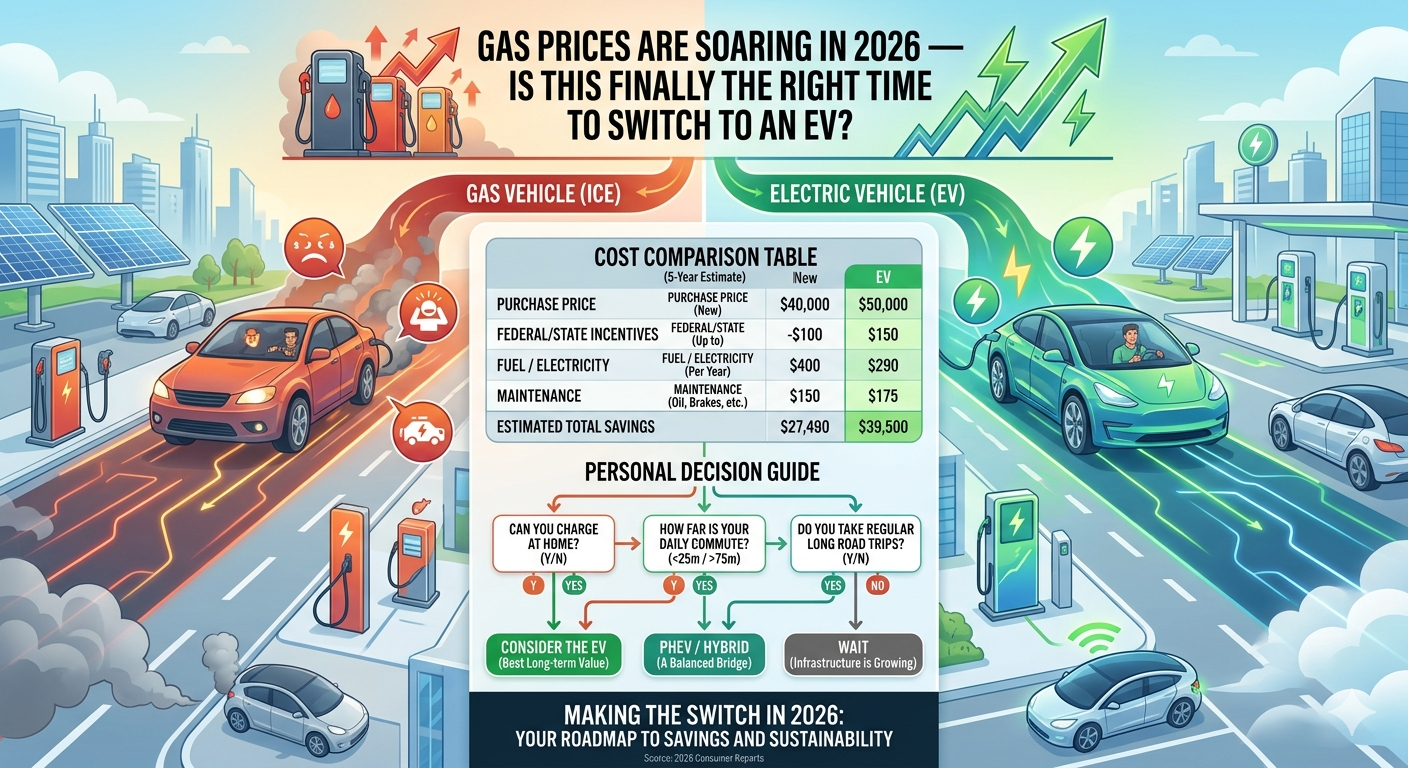
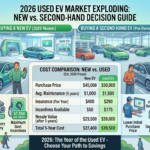
If you have flexibility and can stretch to $40,000+, a new EV in 2026 makes sense, especially with gas where it is. The lack of federal tax credit stings, but the near-parity in 5-year total cost of ownership is real, and you get full warranty coverage with zero battery uncertainty.
If your budget is under $35,000 — or especially under $25,000 — the used EV market right now is genuinely one of the best opportunities in the history of consumer EVs. Prices are at historic lows, supply is the highest it’s ever been, and battery technology from 2021–2023 vehicles is solid and well-understood.
My brother-in-law ended up buying a CPO 2022 IONIQ 5 from a Hyundai dealer for $29,400. Battery health came back at 94%. He has warranty coverage through 2030 on the battery. And he’s spending about $48 a month charging it at home.
He texted me last week: “I filled up at the gas station by mistake out of habit. Sat there for a second and then drove away. Forgot I don’t do that anymore.”
That’s really the whole pitch right there.
Sources: Cox Automotive Q1 2026 market data, Edmunds April 2026 analysis, CNBC used EV ownership report (May 2026), AAA Gas Price Tracker, Plug In America PlugStar tool.