A few months ago, a friend of mine who bought a new electric SUV texted me something that caught me off guard. He wasn’t complaining about range or charging. He said: “I went through two sets of front tires in 18 months. What’s going on?”
He’d done everything right — rotated the tires on schedule, kept the pressure correct, didn’t drive like a maniac. But his EV chewed through rubber in a way his old Honda CR-V never did. When he took it to the shop, the mechanic shrugged and said, “Yeah, these cars are just heavy.”
That’s the conversation the EV industry has been quietly avoiding. Not whether EVs are good — they are, for a lot of reasons. But there’s a real, growing engineering problem sitting underneath the glossy headlines about range and charging speed: electric cars have been getting heavier with every generation, and that weight is starting to cause problems nobody budgeted for.
The good news is that China — home to the world’s largest EV market and its most aggressive battery manufacturers — is now throwing serious engineering firepower at fixing it. What they’ve unveiled in 2026 is genuinely fascinating, and it matters for anyone who owns or plans to buy an EV.
Let me explain all of it in plain English.
First: Why Are EV Batteries So Heavy?
The simple answer is that storing electricity is physically expensive. Not just in money — in mass.
A gallon of gasoline weighs about 6 pounds and contains roughly 132 kilowatt-hours of energy. A lithium-ion battery pack that holds the same amount of usable energy would weigh somewhere around 1,500 to 2,000 pounds — depending on the chemistry. That’s not a fair comparison because gas engines waste most of that energy as heat and EVs are far more efficient, but the underlying point stands: batteries are dense, and they’re heavy.
The average battery pack in an EV on sale today weighs approximately 1,000 pounds. Some outliers — like the battery in a GMC Hummer EV — approach 2,900 pounds. That’s nearly as heavy as an entire compact gas car.
The result? Most EVs weigh about 20 to 30 percent more than comparable gas-powered vehicles. That extra mass is like permanently strapping four or five adult passengers into your car and never letting them out, ever, under any circumstances, for the entire life of the vehicle.
That sounds abstract until you think about what it means in practice.
What All That Weight Actually Does
To your tires: This is where my friend’s problem comes from. Adding weight to a vehicle increases tire wear — and that effect is compounded by EV torque delivery, which is instant and aggressive even when you’re being gentle. Several tire manufacturers have confirmed that EVs wear tires 15 to 20 percent faster than comparable gas cars on average, with some models pushing that to 30 percent. Many mainstream EVs need new tires around 20,000 to 30,000 miles rather than the 40,000 to 50,000 miles gas car owners expect. Budget an extra $200 to $400 per year just for rubber, especially on heavier crossovers.
To the roads: A University of Leeds study calculated that the average EV causes 2.24 times more stress on road surfaces than a comparable petrol car. This is why Alberta, Canada introduced a $200 annual fee specifically for EV owners in 2025, citing extra road wear. The damage is still far less than what heavy trucks do, but as millions of EVs replace lighter gas cars, it adds up across an entire road network.
To braking distances: Heavier vehicles take longer to stop. It’s physics. EVs partially compensate with regenerative braking, but the extra mass still affects stopping distances in emergency situations — and pedestrian safety advocates have flagged this as a growing concern as EVs proliferate in urban environments.
To parking structures: Older parking garages were engineered around assumptions about vehicle weight that no longer hold. The shift toward heavy EVs has engineers quietly reviewing load calculations for structures built decades ago.
To the car itself: The extra mass puts more stress on suspension components, wheel bearings, and brakes — even with regenerative braking doing most of the work. It also affects efficiency in ways that partially undercut the advantage of going electric in the first place. A heavier car requires more energy to accelerate, which reduces range. To compensate for weight, manufacturers add more battery capacity, which adds more weight. It becomes a self-reinforcing spiral.
The industry has a term for this: the “battery weight spiral.” And it’s been quietly getting worse with each generation of EVs as manufacturers chased longer range by simply adding more cells.
Why China Is Taking This More Seriously Than Anyone Else
Here’s where it gets interesting.
China has the world’s most competitive EV market. Dozens of manufacturers are fighting for the same buyers, and those buyers have started asking sharper questions. Chinese consumers have been early and enthusiastic EV adopters, which means they’ve also been the first to notice the weight problem at scale — in tire bills, in handling on tight urban roads, and in the energy efficiency numbers that don’t quite match the spec sheets.
Chinese regulators have also started applying tighter efficiency standards that effectively penalize heavy vehicles. If your EV weighs too much relative to its range, it gets a worse efficiency rating, which affects how it’s taxed and subsidized. That’s a very direct financial incentive for manufacturers to put their batteries on a diet.
The result is that China’s two biggest battery companies — CATL (the world’s largest battery maker) and BYD — have been locked in an increasingly aggressive engineering arms race in 2026, with weight reduction as one of the central battlegrounds.
What CATL Just Unveiled
On April 21, 2026, CATL held what it calls “Super Tech Day” in Beijing, and it was genuinely one of the more impressive engineering announcements in the EV industry in years.
The headliner for the weight story was the third-generation Qilin battery. A 125 kWh Qilin 3 pack weighs 625 kg — and critically, that is 255 kg lighter than a comparable lithium iron phosphate battery pack delivering the same capacity. To put that in perspective, 255 kg is roughly the weight of three adult passengers. CATL itself pointedly noted at the event that “any battery pack over 750 kg is a waste” — a direct jab at heavier competitors.
That 255 kg reduction isn’t just about making the car lighter. CATL says it shaves 0.6 seconds off the 0 to 100 km/h acceleration time, improves handling, shortens braking distances, and reduces stress on suspension components — all from removing weight alone, without touching the motor or software.
Then CATL went further with something called the Qilin Condensed Battery. This one uses what the company describes as aviation-grade technology — specifically a titanium alloy case that is 60 percent thinner and 30 percent lighter than conventional housings, while being three times stronger. The energy density reaches 350 Wh/kg, enabling a pack weighing under 650 kg to deliver 1,500 km of range in a sedan or over 1,000 km in a full-size SUV. Compared to a standard lithium iron phosphate equivalent, the Qilin Condensed is approximately 200 kg lighter.
The “condensed” name refers to what other manufacturers call a semi-solid-state battery — a hybrid design that partially replaces the liquid electrolyte inside the battery cell with a more stable, denser material. It’s not quite the full solid-state battery that everyone keeps calling the “holy grail,” but it’s a meaningful step in that direction, and it’s closer to production-ready than true solid-state.
What BYD Is Doing
BYD isn’t sitting still. In March 2026, the company released its second-generation Blade Battery — an update to the flat, blade-shaped lithium iron phosphate cells that BYD pioneered and that became widely recognized as one of the safest battery designs in the industry.
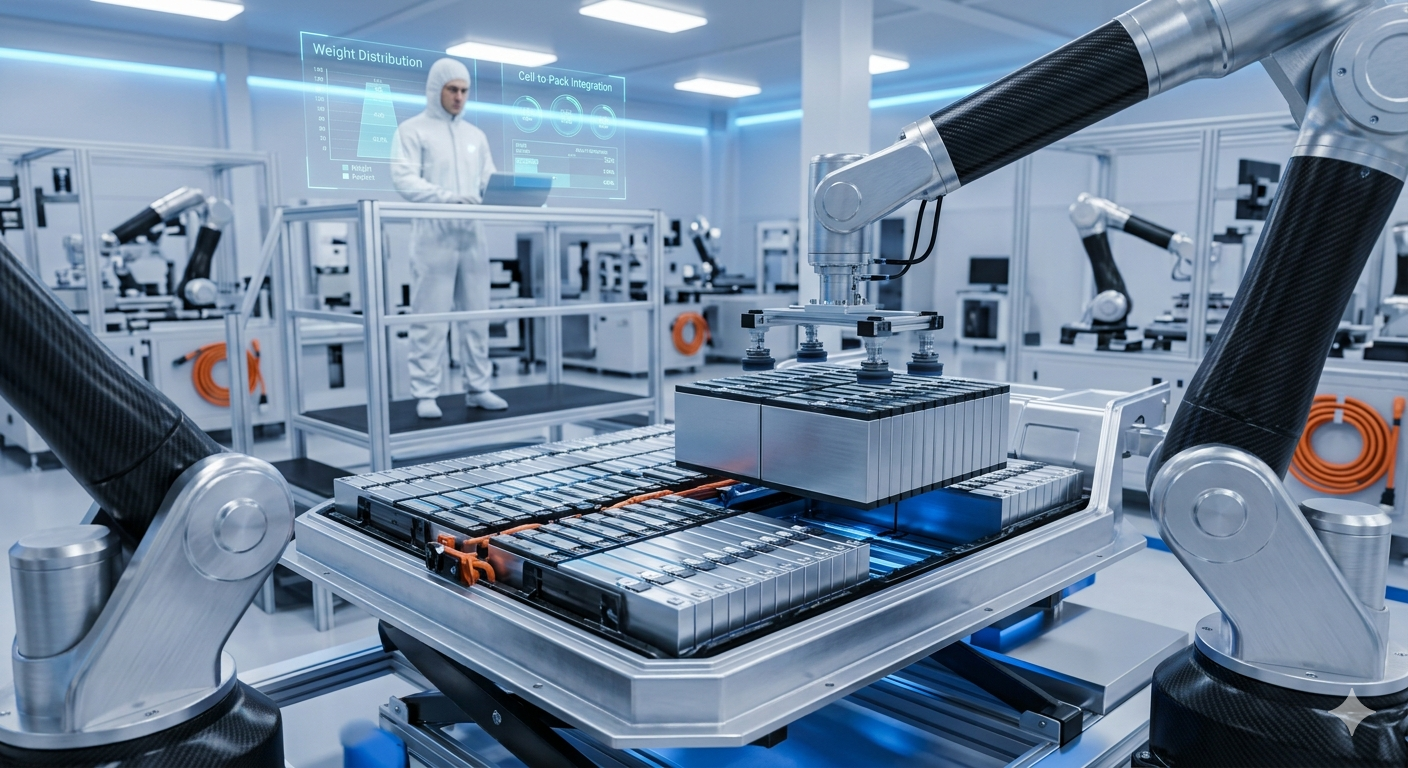
The Blade Battery 2.0 achieves a 10% to 70% charge in five minutes and 10% to 97% in nine minutes — genuinely rapid numbers. On the weight front, BYD’s approach has been different from CATL’s. Rather than switching chemistry, BYD has focused on something called cell-to-pack integration, where individual battery cells are packed directly into the vehicle structure without intermediate modules. Removing those modules saves weight and space, and it lets the battery pack itself serve as a structural component of the car’s floor — killing two birds with one stone.
The result is a more space-efficient and slightly lighter pack than earlier designs, though BYD’s LFP chemistry still carries an inherent weight disadvantage compared to CATL’s higher-energy-density nickel-manganese-cobalt approach. The trade-off is that LFP is cheaper, longer-lasting, and safer — no small thing when you’re putting a large battery pack under someone’s car.
The Sodium-Ion Wildcard
There’s a third chemistry worth understanding here, and it might be the most interesting long-term play on the weight problem.
Sodium-ion batteries use sodium instead of lithium as the charge carrier. Sodium is dramatically more abundant and cheaper than lithium, and sodium-ion cells can be manufactured without cobalt or nickel — expensive and ethically fraught materials. They also perform much better in cold temperatures, which is a known weakness of lithium-ion chemistry.
Weight-wise, sodium-ion cells are slightly heavier per unit of energy than the best lithium-ion designs, which sounds like the wrong direction. But the key insight is that sodium-ion batteries could replace lithium-ion in the smaller, shorter-range urban EVs where absolute weight efficiency matters less and cost matters most. Shifting millions of city cars to sodium-ion would free up lithium and nickel resources for the premium long-range EVs that genuinely need high energy density — and potentially bring down overall battery costs across the industry.
CATL confirmed at Super Tech Day that its Naxtra sodium-ion battery will enter full-scale mass production by the end of 2026, making it the first sodium-ion battery to reach GWh-scale production globally. That’s not a lab announcement — that’s a commercially ready product.
The Solid-State Endgame
The longer-term fix for the weight problem is solid-state batteries, and China is moving faster toward standardizing them than any other country.
China’s National Automotive Standardization Technical Committee released its first national standard for solid-state EV batteries earlier this year, open for public comment with a final version expected in July 2026. Several Chinese automakers — including FAW Group, GAC, and SAIC — have vehicles in testing with semi-solid-state packs right now.
True solid-state batteries replace the liquid electrolyte in conventional lithium-ion cells with a solid material. The benefits are significant: higher energy density (meaning more energy in less space and weight), no risk of the electrolyte leaking or catching fire, and potentially much faster charging. Ganfeng Lithium, one of the major players in this space, is working on cells with energy densities of 400 to 500 Wh/kg using lithium metal anodes — roughly double the energy density of today’s best commercial batteries.
Double the energy density means roughly half the weight for the same range. That’s the number that would genuinely solve the battery weight spiral. CATL and BYD both aim to begin producing solid-state batteries on a small scale around 2027, with mass production toward the end of the decade.
What This Means for You Right Now
If you’re buying an EV today, the weight story has some practical implications worth knowing.
When comparing models, look at curb weight. Two EVs with similar ranges can differ by 300 to 500 pounds depending on battery chemistry and pack design. The lighter one will generally be easier on tires, more responsive to drive, and slightly more efficient.
Budget for tires honestly. Factor in tire replacement every 20,000 to 30,000 miles on heavier models, and look for EV-specific tires from manufacturers like Michelin or Continental — they’re designed with reinforced sidewalls and stiffer compounds to handle the extra load without wearing as fast.
Pay attention to battery chemistry in spec sheets. LFP (lithium iron phosphate) batteries are heavier but cheaper, longer-lasting, and very safe. NMC (nickel manganese cobalt) batteries are lighter and more energy-dense but cost more. Neither is universally better — it depends on what you’re prioritizing.
The next two to three years will matter a lot. The batteries coming out of China’s engineering arms race in 2026 — CATL’s Qilin 3, BYD’s Blade 2.0, the incoming sodium-ion packs — represent a meaningful step toward lighter, denser energy storage. EVs using these technologies will start hitting the market in 2027 and beyond. If you’re buying used or waiting for a specific model, this is relevant context.
The Bigger Picture
There’s something genuinely remarkable about what’s happening in Chinese battery labs right now. The engineering problems being attacked — weight, energy density, charging speed, cold-weather performance, raw material dependency — are being addressed simultaneously, not sequentially. CATL unveiled six distinct battery technologies in a single 90-minute presentation in April. BYD responded with its own rapid-fire announcements weeks earlier. The pace is unlike anything happening in US or European battery development.
My friend with the worn-out tires is driving a first-generation EV by the standards of what’s coming. Within a few years, the cars rolling off Chinese production lines — and increasingly the Western cars using Chinese-made cells — will be measurably lighter, with more range, charging faster, and causing less tire wear than anything on the road today.
The battery weight problem is real. But for the first time, the solution is also starting to look real.
That’s a sentence the EV industry has been waiting a long time to say.
Sources: CATL Super Tech Day announcements (April 21, 2026), CarNewsChina, Charged EVs, Carscoops, Autoevolution, Canary Media, Recharged.com, Electrek (solid-state battery standardization), Battery-Tech Network, CleanTechnica.